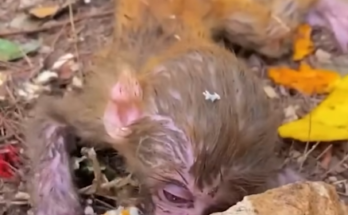
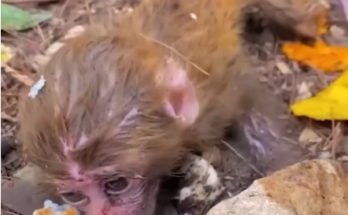
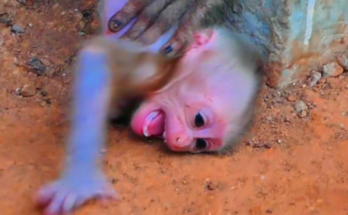
Baby monkeys share an intense bond with their mothers, especially during the early stages of life. This connection is a critical part of their survival, emotional development, and social learning. A small baby monkey clings tightly to its mother as an instinctive behavior, seeking both comfort and security. The physical contact between a mother monkey and her baby not only provides warmth but also reassures the baby of its safety in an unfamiliar and often unpredictable environment.
In these moments, removing the baby from its mother is not only physically challenging but also emotionally distressing for both. The baby monkey’s strong grip is a natural reflex, an evolutionary adaptation to ensure it does not fall or get separated while its mother moves around, often navigating through trees or rough terrain. This clinging behavior is also a reflection of the deep dependency that the baby has on its mother for nourishment, protection, and guidance.
For the mother, her protective instincts make her reluctant to let her baby go. She will often push away any external attempts to separate them, using physical gestures or even vocalizations to express her resistance. Such actions highlight the depth of maternal instincts in monkeys, which are comparable to the strong bond seen in many other mammals, including humans.
This close connection underscores the importance of family bonds in primate societies. Attempts to separate a baby monkey from its mother can cause significant stress and disrupt their emotional well-being. For conservationists and animal caretakers, such interactions are approached with great care and sensitivity, ensuring minimal distress to both mother and baby. Observing this behavior offers profound insights into the natural instincts of primates and the universal significance of a mother’s love in the animal kingdom.