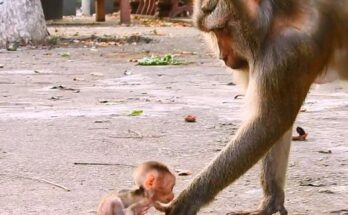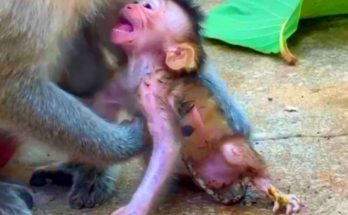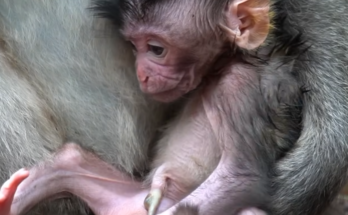
In the heart of the forest, where life thrives in chaotic balance, an unsettling scene has left observers both shocked and saddened. A mother monkey, usually the very embodiment of care and nurturing, appears to reject her newborn baby. The small, fragile infant reaches out with trembling fingers, instinctively seeking the warmth and safety of its mother’s embrace. But instead of pulling the baby close, the mother turns away, her body language distant and detached. For those watching, it’s a deeply troubling moment that raises a heartbreaking question: What’s wrong with the baby monkey?
In the wild, the bond between a mother and her infant is critical. For monkeys, this bond ensures not just physical survival but emotional security as well. A baby monkey depends entirely on its mother for nourishment, warmth, and protection in its earliest days. Normally, mother monkeys are fiercely protective, constantly grooming, feeding, and holding their babies close. So, when a mother visibly withdraws or refuses to care for her newborn, it signals that something has gone terribly wrong.
There could be several reasons behind this shocking behavior. One possibility is that the baby monkey is weak, sick, or born with deformities that the mother instinctively recognizes. In nature, survival is a harsh game, and mothers may abandon or reject babies they sense have little chance of making it. To human eyes, this seems unbearably cruel, but in the wild, it is often a way to conserve energy and resources for future offspring or the rest of the troop.
Another reason could lie in the mother’s own condition. If she is stressed, malnourished, or inexperienced (especially if it’s her first baby), she may lack the physical or emotional capacity to care properly for her infant. The demands of motherhood are intense, and without adequate support from the environment or the troop, some mothers may simply shut down, unable to provide the care their baby so desperately needs.
Observers have also noted that in some primate groups, social dynamics play a role. A lower-ranking mother may face pressure from dominant females or aggressive males, making her more likely to neglect or reject her baby under stress or threat. It’s a chilling reflection of how the complexities of social hierarchies in primate societies can have devastating consequences.
As the baby monkey reaches out, its faint cries are met with indifference. It struggles to latch onto its mother, crawling weakly, but she moves away. The sight is almost too much to bear — a helpless infant left to fend for itself, its tiny body growing weaker with each passing hour.
This moment is more than just shocking; it’s a stark reminder of nature’s brutal realities. While we often romanticize the wild, scenes like this strip away any illusions. The maternal bond, though powerful, is not immune to the pressures of survival. Watching a mother monkey reject her baby forces us to confront uncomfortable truths about life’s fragility, the role of instinct, and the fine line between care and abandonment in the animal kingdom.