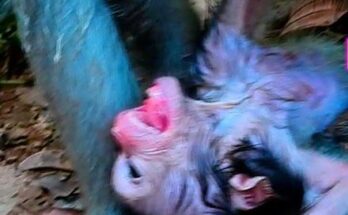
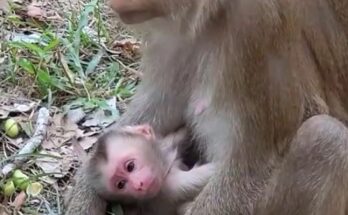
The forest was quiet except for the tiny cries of a newborn monkey, his weak voice rising in the humid morning air. He clung to his mother’s chest, trembling, his thin arms wrapped around her fur as if afraid to let go. His little mouth searched again and again, hoping to find the comfort of nourishing milk — but it never came. His mother, though she held him tightly and tried to soothe his whimpers, had no milk to give.
She was young, this mother monkey, and her body hadn’t fully recovered from the birth. Her eyes, once bright, now held exhaustion and helplessness. She tried everything — grooming him gently, pressing him close, keeping him away from the other curious monkeys — but nothing could quiet the baby’s desperate cries for milk. She looked down at him often, her face lined with sorrow, knowing her baby was hungry and growing weaker each hour.
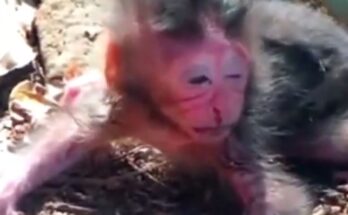
Each day, the tiny infant grew quieter, his cries thinner, his movements slower. His skin lost its healthy warmth, and his limbs seemed almost too fragile to support him. He didn’t try to lift his head anymore; instead, he lay against her chest, rising and falling with her shallow breaths. His search for nourishment turned to small, defeated movements — tiny nudges, a soft lick, then stillness. The jungle, usually a place of energy and life, felt heavy with the weight of his silent suffering.
Other mothers in the troop nursed their babies nearby, their healthy infants crawling, playing, and suckling with ease. The contrast was painful. This young mother kept her distance, retreating with her baby to quiet corners, trying to hide her pain. Some of the older monkeys looked on with empathy; others, with indifference. Nature is often unforgiving, and the weak are sometimes left behind. But this mother would not give up.
She carried her baby everywhere — cradled him in her lap while she searched for food, shielded him from the rain with her own body, and even gently rocked him when he grew too cold. Her instincts were strong, her heart full of love, but it wasn’t enough. Milk was life, and her body couldn’t give it.
As the sun dipped below the treetops, casting long shadows on the forest floor, the baby let out one final cry — softer than before, almost like a whisper. He buried his face into his mother’s fur, still hoping, still longing. She held him tighter, sensing the change, and closed her eyes. For a long time, she didn’t move.
That night, the forest grew still. The moonlight touched the leaves, and the troop settled in. One mother and her baby stayed curled beneath a tree, hearts beating in slow rhythm. Though nature had taken its course, the story was not just one of loss — it was a testament to the power of love, even in helplessness. A mother’s bond, even when her body fails, holds strong through every cry, every breath, and even in the silent moments when hope fades.