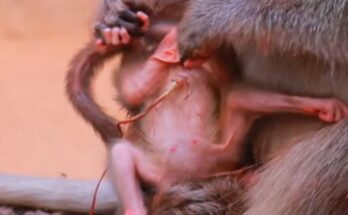
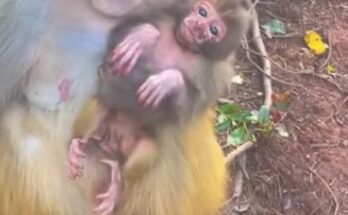
In a heart-wrenching scene from the animal kingdom, a tiny newborn monkey was seen desperately trying to nurse, only to be met with rejection by its mother. The fragile infant, barely strong enough to hold its head up, clung tightly to its mother’s fur, instinctively seeking comfort and nourishment. Its small mouth gaped open, searching for the sustenance it needed to survive, but the mother turned away, withholding her milk despite the baby’s visible distress.
Such scenes, though difficult to witness, are not entirely uncommon in the wild. A mother monkey refusing to nurse her baby can stem from a variety of reasons. In some cases, the mother might sense that something is wrong with the infant—an underlying illness, a developmental issue, or weakness that reduces its chances of survival. In the harsh realities of nature, where resources are limited and survival is paramount, mothers may instinctively choose to invest their care in offspring who show the strongest chance of thriving.
The baby monkey, unaware of this cold biological calculus, continued to cry out in soft, high-pitched squeals, pawing at its mother’s chest. It nestled close to her, trying again and again to latch on, only to be gently pushed away. The mother’s eyes occasionally glanced down, but her demeanor remained distant, almost resigned. She seemed torn—her body close, but her instincts telling her not to give in.
This heartbreaking interaction highlights the complex emotional and instinctual behaviors in primates, creatures whose social dynamics often mirror our own. It’s easy to anthropomorphize the scene, to see it through a human lens and assume cruelty or indifference. But for animals, especially in the wild, decisions are often dictated by hardwired survival instincts, not malice.
Observers and wildlife experts often find such moments difficult to accept. In sanctuaries or rescue environments, interventions might be made—caretakers could step in to feed the infant with a bottle or try to encourage maternal bonding. In the wild, however, such outcomes are left to nature. Some infants eventually find foster mothers within the troop, especially in highly social species like macaques or langurs, but many are not so fortunate.
The scene of the tiny monkey’s struggle leaves a lasting impression. It reminds us of the fragile balance of life in the animal world, where not all stories have a happy ending. It also stirs questions about maternal instincts—how they vary, when they fail, and the ripple effects of those failures.
As the baby monkey huddled against its mother, still trying despite repeated rejection, it painted a poignant picture of both innocence and desperation. Whether the mother would eventually relent, whether another monkey would step in, or whether the infant would succumb to hunger remains unknown. What is clear, though, is that this scene serves as a stark and emotional reminder of nature’s beauty—and its brutality.